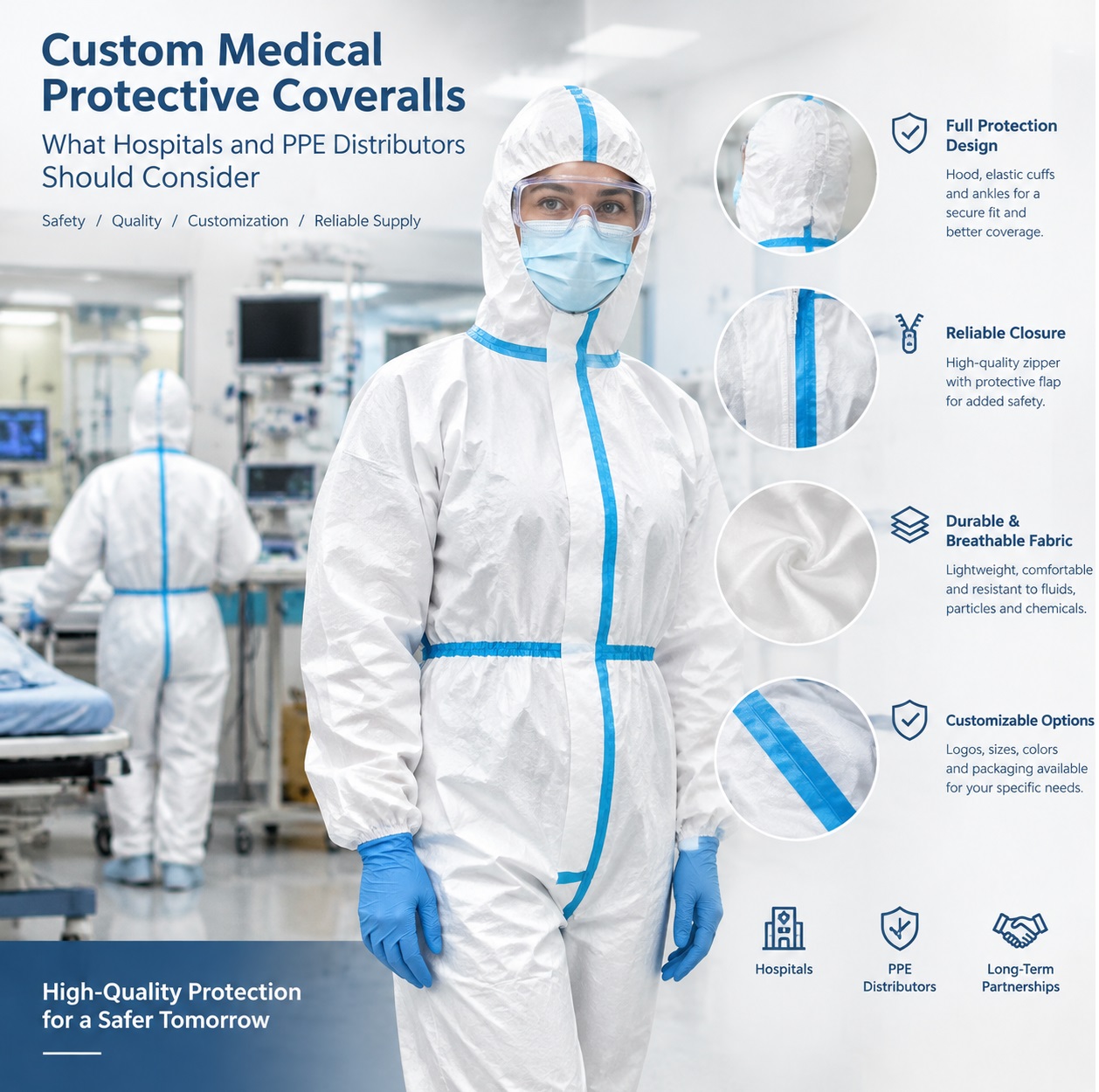
 Walk into any hospital procurement office and ask about the last time a coverall order went perfectly. You will get a tired laugh. The gap between what arrives on a pallet and what a nurse actually needs at 3 a.m. in an isolation ward is where money, safety, and reputations get lost. Custom medical protective coveralls exist to close that gap, but only if buyers know what they are actually specifying. Here is what matters before you sign a purchase order.
Start with the fabric, not the price tag.
Most sourcing conversations open with cost per unit. That is backwards. The fabric decides everything downstream: breathability, barrier performance, comfort during a twelve-hour shift, and whether the garment passes the standard your facility claims to follow. SMS (spunbond-meltblown-spunbond) is the workhorse for general isolation and low-fluid scenarios. SMMS adds another meltblown layer for better filtration. Microporous film laminates step up fluid resistance for surgery and splash-heavy environments. Then there is the heavy artillery, such as flash-spun polyethylene, reserved for high-risk zones where viral penetration resistance is non-negotiable.
Ask your supplier for the exact composition, not a vague promise of “high quality material.” If they cannot name the layers and the weight in grams per square meter, keep walking.
Certification is where cheap coveralls fall apart.
A coverall can look identical to a certified one and fail every meaningful test. Demand documentation for the standards that apply to your market. In the United States, that usually means ANSI/AAMI PB70 levels for barrier performance, plus ASTM F1670 and F1671 for bloodborne pathogen and viral penetration resistance. In Europe, look for EN 14126 for infective agents and the relevant Type ratings, typically Type 3 and 4 for liquid-tight and spray-tight protection, with Type 5 and 6 covering particle and limited splash risks.
Certificates should come from accredited labs, and they should match the exact model you are buying. A certificate for a different fabric weight or a discontinued style is worthless. Distributors who resell under their own label carry an extra burden here: they own the liability if the paperwork does not hold up.
Fit is a clinical issue, not a comfort luxury.
An ill-fitting coverall gets torn at the shoulder, snagged on a door handle, or left half-zipped because the wearer cannot move properly. That is a breach waiting to happen. Custom sizing programs address this directly. Instead of the standard small-through-XXL spread that fits almost no one well, custom manufacturing lets you adjust torso length, sleeve length, inseam, and hood dimensions.
Hospitals with diverse staff populations benefit most. A coverall cut for a 175 cm frame hangs dangerously loose on a 160 cm nurse and restricts a 190 cm physician. Distributors can turn this into a genuine selling point: a sizing program that reduces waste from unused sizes and returns from poor fit.
Seams and closures deserve their own conversation.
The fabric is only as protective as its weakest stitch. Look at seam construction. Serged seams are fine for basic applications. Bound seams offer more durability. Taped seams, where a heat-sealed strip covers the stitch line, are the standard for liquid-tight and viral barrier requirements. If your clinical environment involves high fluid exposure, taped seams are not optional.
Then check the zipper and storm flap. A coverall with a flimsy zipper and no flap over it leaks at the front, which is exactly where contamination concentrates. Elastic cuffs, thumb loops, and ankle closures also vary widely. Thumb loops sound trivial until you watch someone’s sleeves ride up mid-procedure.
Customization goes beyond size.
Branding matters for distributors. Private-label coveralls with your logo, your size charts, and your packaging build recognition and customer loyalty. Hospitals may want color coding by department or hazard level, which speeds up donning during emergencies. Some buyers request individual poly-bagging for sterile-adjacent environments, while others need bulk-packed cartons for high-volume storage.
Think through the entire chain: how the product arrives, how it is stored, how it is dispensed, and how it is disposed of. A custom program that ignores any of these stages creates new problems instead of solving old ones.
Supply chain reliability is the quiet dealbreaker.
PPE shortages during recent health crises taught everyone a hard lesson. A supplier who cannot guarantee consistent lead times, raw material access, and production capacity is a liability regardless of unit price. Ask about manufacturing locations, backup production lines, and inventory buffer policies. For distributors, ask whether your supplier can hold safety stock for your key accounts.
Also clarify minimum order quantities early. Custom coveralls usually carry higher MOQs than off-the-shelf products because of tooling and material runs. If your volumes are modest, a good manufacturer will help you find a middle path, such as semi-custom sizing with standard fabric, rather than forcing you into an all-or-nothing commitment.
The uncomfortable question about cost.
Custom coveralls cost more per unit than generic imports. That is a fact. But the comparison is incomplete without factoring in waste, returns, worker downtime, and incident risk. A coverall that fits properly and performs as certified reduces the hidden costs that never show up on the invoice. For distributors, a differentiated product line protects margins in a market where commodity coveralls compete almost entirely on price.
Run the numbers honestly. If your annual volume is low and your risk profile is minimal, standard sizes may be enough. If you operate in high-acuity environments or supply customers who do, custom is not an indulgence. It is risk management.
Practical steps before you commit.
Request physical samples in multiple sizes and have actual clinical staff wear them during simulated tasks. Test the donning and doffing process, because a coverall that is hard to remove safely is a design failure. Verify every certificate against the exact model number. Visit or video-audit the production facility if volumes justify it. And put performance guarantees in the contract, not just delivery dates.
Hospitals and distributors both sit in a market that rewards careful specification and punishes shortcuts. Custom medical protective coveralls give you control over fit, barrier performance, branding, and supply consistency. That control is worth having, provided you ask the right questions before the first order ships rather than after the first complaint arrives.